Dakhla
|
|
|
|
|
|
|
Dakhla
|
|
|
|
|
|
|
Gravel from broken pottery?Date pits turned to stone?
From Cairo, it's a one-way trip of 11 hours on adequate 2-lane roads, but that long and somewhat tedious journey prepares the passengers for the step back in time that the oasis presents. |
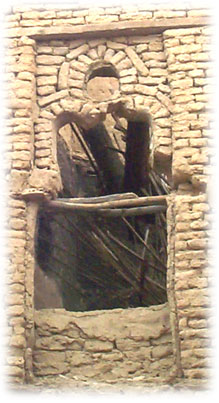
Al-Qasr: Medievel mud brick walls Window with Mamluk arches |
|||
|
Five archeologists shared their passion
about the planning, excavation and restoration of their sites during our
visit organized by the American Research Council (ARCE).
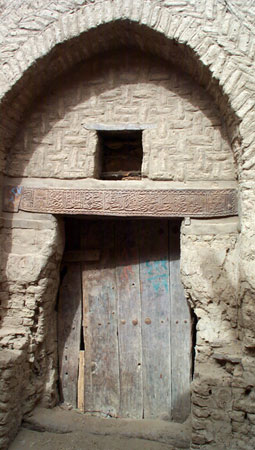
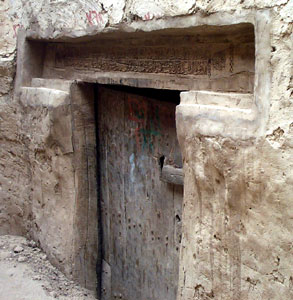
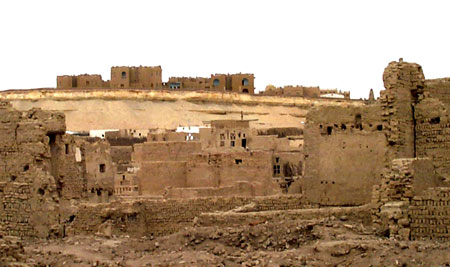
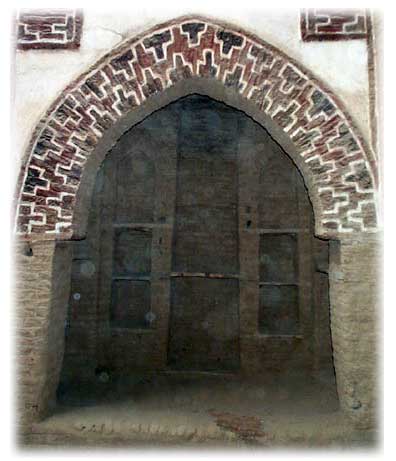
Al-QasrIn Al-Qasr, a mostly uninhabited medieval Islamic capital (15th to 17th century), many doorways have a wooden lintel over the top that names the inhabitants, the carver and the year -- with the oldest from 1519. Because of encroaching sand, the doors are much shorter today than originally built. A Dutch archeologist, spoke of finding more than 400 folded paper documents while we stood in one rubble-filled room that opened to the sky. When they restore the moisture to the paper the letters can be unfolded and read.The crew found a metal seal nearby with the woman's name, Helima. The experts decided that a woman at that time wouldn't be important enough to have a seal and labeled it for later analysis. A few minutes later they found a letter from Helima's son, explaining that he had sent her a bolt of silk to sell. It seems Helima was a 17th century businesswoman! |
|||
|
This community was quite wealthy, perhaps
from slave trade or water rites, as seen from the school, decorated interior
bricks and indoor toilets – an enclosed narrow shaft that ran the height
of the building.
The newly opened Desert Lodge Resort can be seen on the upper most hill, using ancient colors and design to blend in. |
|||
...more on Al-Qasr
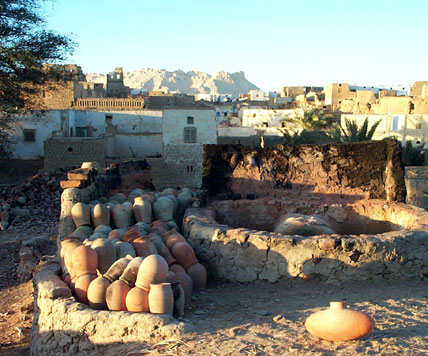
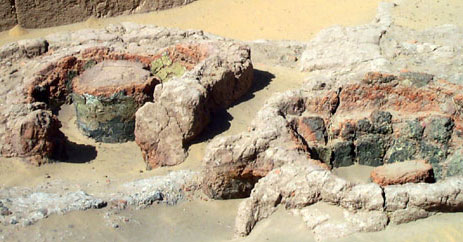
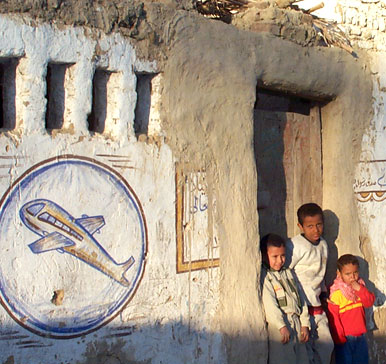
The ancient kilns (photo in center) were found at Ain Asil. The airplane shows the resident has recently been to Makkah for the Hadj. (photo to left) |
Click on photos
to enlarge.
|
|||
|
Deir el Haggar
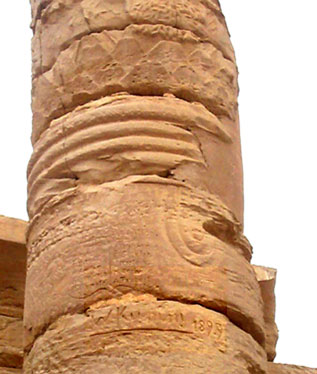
In fact, one of the columns had graffiti
-- the names and dates of 19th century explorers -- about 6 feet up today.
Earlier that top section protruded from the sand at ground level.
|
|||
 |
Amheida
Much of Amheida, (Dr. Bagnall – Columbia)
is in the mapping stage, so you walk on stone paths, that are brushed off
to mark the tops of some walls, the areas in between filled with an estimated
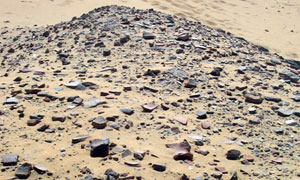
billion pieces of pottery mixed with sand. The potsherds are in fragments
of sizes from three to six inches and so dense that the pottery was like
gravel,
crunching and breaking under foot.
Theory has it that mud brick houses had pottery jars for storage on the roofs (Seen in villages today too.) and when the walls collapsed and disintegrated, the pottery fell and broke. As the pots were fired, they are stronger than the walls and therefore survive albeit in pieces. Sergei and Tatiana explained how the magnetometer takes readings that convert to maps of the underground areas. |
|||
Al-Qasr: Teacher's room in medieval school Extra bookselves! |
Qila
el-Dab'a & Ain Asil
The archaeology site is partially excavated and restored by the French, complete with a half domed funeral chamber and ancient kilns explained Georges Soukiassian, the director. The potsherds covering most of the sandy areas are much less dense than in Amheida. In one section the sand is littered with date pits that fossilized to stone pebbles - 2000 years old. Sand and desert dryness preserve in incredible ways! |